False Ceiling Guide: Gypsum vs POP, Cost and Cove Lighting
D'leaps Design Desk · 2026-08-08
Gypsum vs POP false ceiling - what each one costs in Hyderabad, which survives our humidity, and how to plan cove lighting before the board goes up.
A client in Hitech city showed us two quotes for the same 3BHK last month. One said POP, ₹95 per sq ft. The other said gypsum, ₹135. Both contractors had told him the same thing - "sir, finish is same, only material name is different."
It isn't the same. And the ₹40 gap isn't where the real money in that decision sits anyway. The lighting he hadn't budgeted for cost him more than the difference between the two ceilings.
So here's the gypsum vs POP false ceiling comparison the way we explain it on site, plus the part almost nobody plans early enough - the light that goes inside it.
Gypsum vs POP False Ceiling: What Actually Separates Them
POP is plaster of Paris, mixed wet on site and applied over a frame, then sanded smooth by hand. Gypsum board is a factory-made panel, screwed onto a GI channel frame, with only the joints filled and taped.
That one difference drives everything else.
Finish. POP done by a good mason gives you a continuous surface with no joints at all, which is a real advantage on curved and rounded designs. Gypsum has joints. They're taped and skimmed, and on a well-executed job you won't see them, but a rushed jointing crew leaves you with faint lines that show up the first time you run a light across the ceiling at a low angle.
Cracking. This is where POP loses in Hyderabad. Wet plaster shrinks as it cures, and if it cures too fast in April heat or too slow in a wet August week, you get hairline cracks along the joints within a year or two. Gypsum board doesn't shrink. It moves at the joints instead, which is why the taping quality matters more than the board quality.
Weight and structure. POP is roughly two to three times heavier per square foot. On a large span that means more framing, more anchors into the slab, and more to go wrong if the contractor skimped on the channel spacing.
Repairs. POP wins here. A cracked or damaged patch can be re-plastered and blended by a mason for a couple of thousand rupees. A damaged gypsum panel usually means cutting out a section and re-boarding it, and matching paint across a repaired gypsum ceiling is fiddly.
Site mess and speed. POP is a wet trade: buckets, spillage, drying gaps between coats. If you're doing interiors while living in the flat, that's a real consideration. Gypsum is a dry install, faster, and cleaner to work around.
Cost. POP runs about ₹65–₹110 per sq ft in Hyderabad; gypsum sits at ₹85–₹150 depending on brand and design complexity. Add 18% GST. We've broken the numbers down room by room in our false ceiling cost guide if you want the full pricing picture.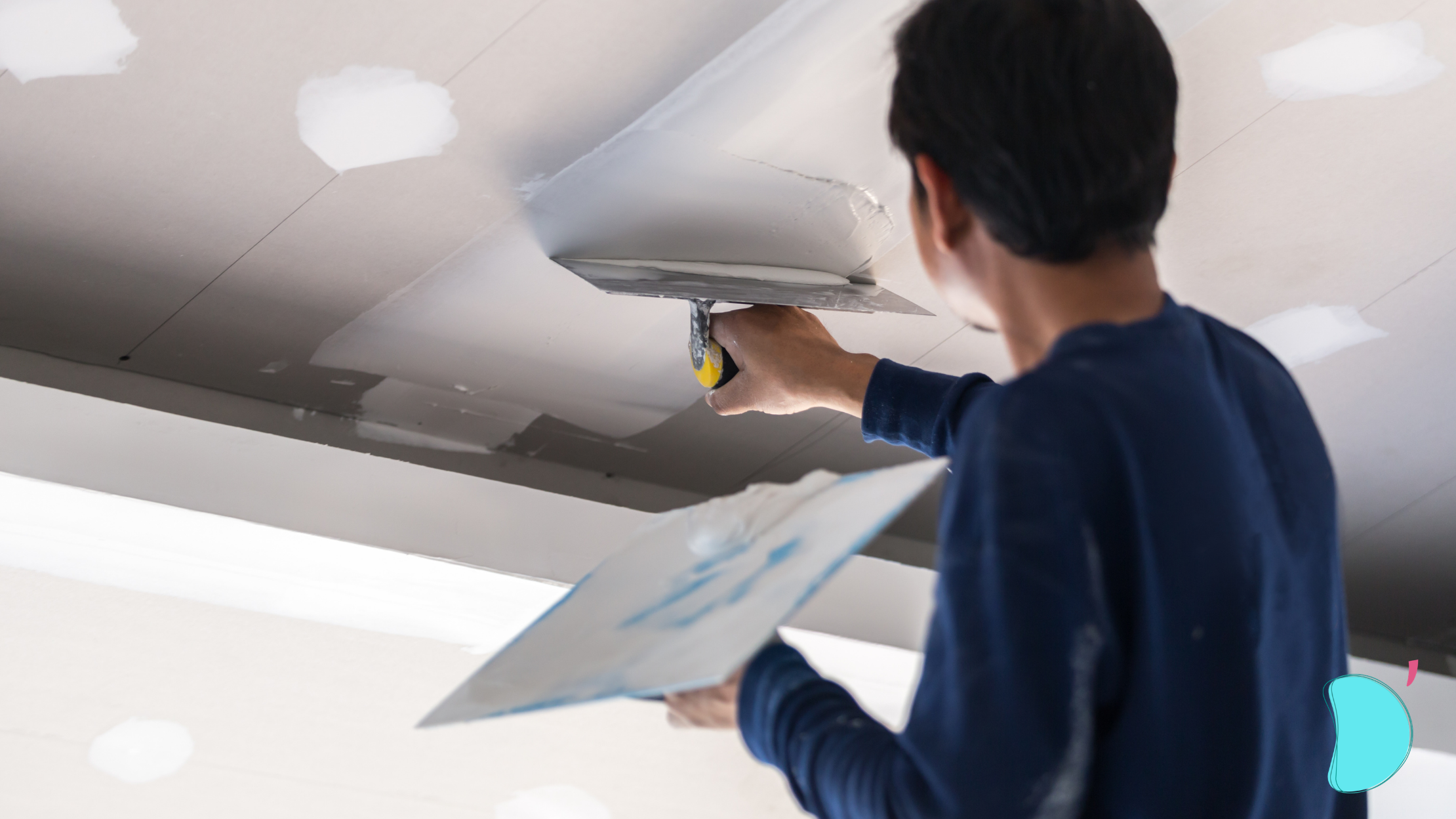
Which One We'd Actually Pick
For a standard flat in Gachibowli, Kokapet, L.B. Nagar or anywhere else in the city, we'd say gypsum, on Gyproc or Saint-Gobain board, over GI channel framing. Not because POP is bad, but because gypsum's result depends less on who shows up to work that day.
We'd choose POP in two situations. One, curved or organic shapes: arched bulkheads, rounded corners, a circular feature over a dining table, where gypsum needs scoring and bending and POP just flows. Two, when there's an existing POP ceiling being patched or extended and matching the surface matters.
The honest trade-off with gypsum: it costs more upfront, and it's less forgiving if you ever want to change the design later. Cutting into a gypsum ceiling for a new light point is a bigger job than chipping into POP.
One thing applies to both. Insist on GI channel framing, not wooden battens. Wood in a Hyderabad flat, especially on lower floors or anywhere with a damp external wall, will move. We've seen four-year-old ceilings sag along a wooden batten line in homes near Uppal and Kompally.
Lighting Is Where a False Ceiling Succeeds or Fails
A ceiling with bad lighting is just a lowered roof. The design work most people obsess over, how many levels and how deep the cove, matters far less than what's sitting inside that cove and what colour it throws.
Cove lighting: use a profile, not a bare strip
The cheapest way to light a cove is to stick a bare LED strip along the ledge. It works, and for about a year it looks fine. Then a few diodes fail unevenly, and because there's nothing diffusing the light, you can see every individual dot reflected on the ceiling as a row of scallops.
An aluminium profile with a frosted diffuser fixes both problems. It spreads the light into an even wash, and it sinks heat, which is the actual reason cheap strips die early. Bare strip runs about ₹120–₹350 per running ft installed. With a profile and diffuser, budget ₹300–₹650 per running ft.
For a living-and-dining cove in a 3BHK, that's typically 60–80 running ft, so ₹20,000–₹45,000 for the lighting alone. That's the line item that ambushes people.
Get the colour temperature right
3000K warm white in living rooms and bedrooms. 4000K neutral in kitchens and study areas where you need to see what you're doing. Nothing at 6500K anywhere in a home. Cool white daylight reads as an office corridor at night, and it makes wood laminates and warm-toned granite look grey and cheap.
Also, keep the temperature consistent across a single sightline. A 3000K cove and 4000K spotlights in the same living room will look like a mistake even to someone who can't name why.
Spotlight spacing that doesn't look like an airport
Recessed COB spots go roughly 3–4 feet apart, and about 2 feet in from the wall if you're washing a wall or artwork. Any closer and you get a grid of hotspots; any wider and you get dark patches between them.
Wattage rule of thumb for a Hyderabad flat: 7W spots for general fill, 10–12W where you need task light. A 12x14 living room needs six to eight spots plus the cove, not the fourteen the electrician will happily quote for. Good COB spots from Philips, Wipro or Havells run ₹350–₹900 each. The ₹120 ones from a local market change colour within eighteen months, and they never all change at the same rate, so you end up with a ceiling of slightly different whites.
Two things to sort before the board closes
Driver access. Every LED strip runs off a driver, and drivers fail before strips do. If yours is sealed inside the ceiling with no service hatch, replacing a ₹900 part becomes a ₹6,000 repair. Ask where the driver sits and how it gets reached.
Dimming. If you want the living room cove dimmable, the driver has to be a dimmable one and the wiring has to run to a dimmer point. Retrofitting that after the ceiling is painted is not a small job. Magnetic track systems, the current premium ask at ₹1,200–₹2,500 per running ft, need the same forward planning plus a deeper recess.
How Much Ceiling Drop Do You Actually Need?
Most Hyderabad flats have a 10-foot slab, some newer gated projects give you 10'6". A cove-lighting perimeter needs 4 inches of drop. Add a concealed AC duct and that stretch goes to 8–10 inches, but only along the duct run, not across the whole room.
The mistake is dropping the entire ceiling to the depth needed by its deepest element. In a compact 2BHK, losing 9 inches everywhere to hide a duct that runs along one wall makes the room feel low in a way you'll notice every single day.
Ask your designer for the drop in inches, room by room, before you sign off.
The Sequence That Saves You Money
Electrical first. Every light point, AC vent, speaker wire and driver location has to be marked and wired before a single board goes up. Then framing, then boarding, then jointing and putty, then paint, then fixtures go in last.
Where jobs go wrong is when the ceiling contractor and the electrician are two separate vendors who've never spoken. The ceiling closes, then the electrician arrives and needs three new points cut into a finished surface. That's exactly why we run false ceiling and electrical work as one coordinated scope rather than two.
Timeline for a 3BHK
Framing takes about 2 days, boarding 2 days, jointing and putty 3 days with drying gaps, paint 2 days, fixtures half a day. So 8–10 working days for a full-flat gypsum ceiling, 3–4 days for a single room.
POP adds 3–5 days to that, mostly drying time between coats. Worth knowing if you're working backwards from a griha pravesham date.
Get a Ceiling and Lighting Plan Together, Not Separately
Send us your floor plan and we'll come back with a false ceiling design, a lighting layout showing every point and its wattage, and one quote covering both - free, no obligation. That way the lighting cost is on the table before you commit to the ceiling, not after.
We work out of L.B. Nagar, Hyderabad and Tirupati, and we've been doing this since 2020.
Get a free modular kitchen quote from D'leaps
Planning your kitchen or a full-home fit-out? Talk to our designers for a free, no-obligation quote and a written completion date.
WhatsApp us on 9121000207 · Call +91 9121000207 · Book a free consultation
Related reading
- Civil Work and Waterproofing Costs in Hyderabad (2026)
Civil work and waterproofing costs in Hyderabad for 2026: real per sq ft rates, which walls you can't break, sunken slab leaks, and honest… - 2 BHK Interior Design Cost in Hyderabad (2026 Guide)
- 3 BHK Interior Cost in Hyderabad 2026: The Honest Guide
What a 3 BHK actually costs in Hyderabad this year - broken down by finish tier, with the questions you should ask any studio before… - Wardrobe Cost in Hyderabad: Sliding vs Openable, Materials & Pricing
What built-in wardrobes cost in Hyderabad, how sliding and openable compare, and which finishes are worth paying for. - Space-Saving Ideas for Small 2BHK Flats in Hyderabad
Small 2BHK space-saving ideas with real measurements: wardrobe, bed, dining and TV sizes, clearances, and the mistakes that eat floor space…