Acoustic Panels Will Not Soundproof Your Bedroom: An Honest Guide
D'leaps Design Desk · 2026-10-17
Your new flat echoes because every surface is hard. Here is what absorbs, what blocks, a 30-second clap test, and what to spend on, in Hyderabad prices.
You walk into your empty 3BHK on handover day, say something to your spouse, and the room answers back. Vitrified tile under you, bare plaster on four sides, a gypsum ceiling 10 feet up, and a glass slider to the balcony. Nothing in that room is soft. Most people assume the echo will go once the furniture comes in. Some of it does. The rest stays, and it is the reason the TV sounds harsh, phone calls are tiring, and two children talking feels like six.
This is the part of interiors that gets no attention until the family has moved in. It is cheap to plan and expensive to patch, so the time to read this is before the false ceiling goes up. If you want to reduce echo in a new flat, you need to know which of two different problems you have.
Echo and noise are two different problems
Sound control has two main jobs, and people mix them up constantly.
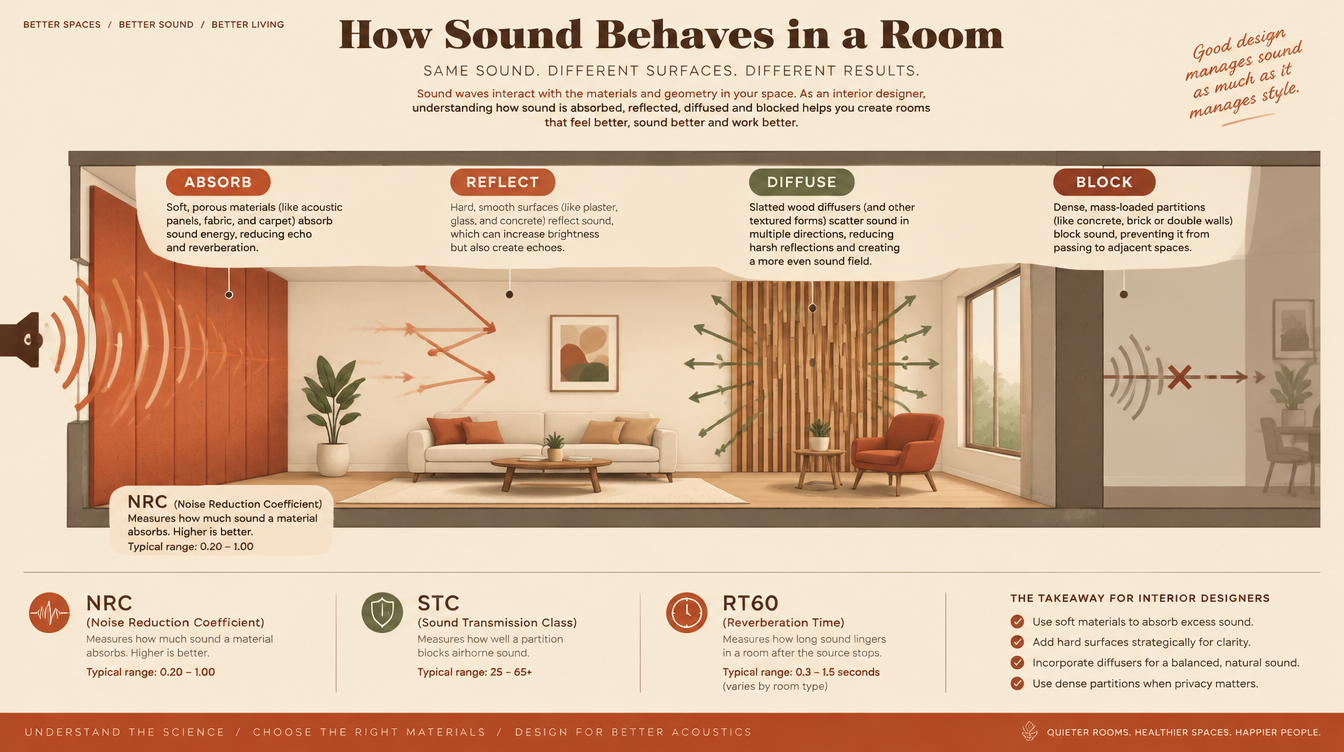
Absorbing is about sound inside a room. Hard surfaces bounce sound back into the room, so a word lingers for a fraction of a second after it is spoken. Soft, porous material soaks that bounce up. Rugs, curtains, upholstered sofas and felt panels all absorb. The industry measures this with NRC, a number from 0 to 1, where 0.9 means a material swallows nearly all the sound that hits it and 0.05 means it bounces nearly all of it back.
Blocking is about sound crossing a wall, a door or a window. That needs mass and airtightness, meaning dense walls, heavy doors and sealed gaps. The measure here is STC, a rating of how many decibels an assembly knocks off as sound passes through it.
Here is the mistake. A homeowner in a new tower hears the neighbour’s TV through the bedroom wall, searches online, and buys foam or felt panels because they are labelled acoustic. The panels go up, the room sounds slightly less bright, and the neighbour’s TV is exactly as loud as before. Soft panels absorb. They do not block. Nothing you stick on a wall surface will stop sound travelling through that wall.
Good news for Hyderabad buyers in post-2016 towers around Kokapet, Narsingi, Tellapur and Gachibowli: those 100 to 150 mm RCC shear walls already block very well. If you are hearing the neighbour, it is almost always coming through a door, a window, or a gap, not the wall itself.
The 30-second clap test
Stand in the middle of the living room with the doors shut. Clap once, hard, and listen. If the clap ends with a short metallic ring or a flutter that lasts half a second or more, the room has an echo problem. If it stops dead, you are fine.
Do it again with your phone recording a voice memo. Play it back and listen for the tail after the clap. Do this in the empty flat, then again after furniture, and you will hear exactly how much your sofa and curtains fixed and how much is left.
A rough target, if you want a number, is a reverberation time of 0.4 to 0.6 seconds in a living room, measured as RT60, the time it takes a sound to drop by 60 decibels. An empty tiled flat is often above 1.2 seconds. You cannot measure RT60 precisely with a phone, but a free app like Decibel X or an RT60 app will get you within range, and the clap test tells you the same thing in plain hearing.
Layer soft things first, buy panels last
Absorption depends mostly on thickness and porosity. It does not depend on whether a material is sold as acoustic. A 12 mm wool rug on a felt underlay absorbs more mid-range sound than a 6 mm foam panel of the same size, and you were buying the rug anyway.
Start here, in order of value per rupee.
A large rug. In an open living-dining area, go to at least 1,800 x 2,700 mm under the sofa set, not a small rug floating in front of it. Add a 6 to 8 mm felt or rubber underlay. Tile floors are the single biggest reflector in a Hyderabad flat, and this is the only thing that covers them.
Lined curtains. A heavy curtain with a lining, hung with at least 2x fullness, covers your biggest glass surface. Sheers alone do nothing for sound. The curtains post in this series covers fullness and fabric metres, so I will not repeat it here.
A fabric sofa over leather or rexine. Fabric absorbs, smooth leather reflects.
An open bookshelf with real books, unevenly filled. This is your first diffuser. A diffuser is a surface that scatters sound in many directions so the room stops ringing without feeling dead. Flat cupboard shutters bounce sound straight back. A shelf with books of different depths breaks the bounce up.
Do these four and clap again. For many 2BHKs the echo is now gone. If it is not, you have an open-plan living-dining with a 10 ft ceiling, and you need one deliberate acoustic element.
Where to put the one acoustic feature
In an open-plan room the ceiling is the largest surface you have not touched, and it is also the one surface nobody puts furniture against. That makes it the best place for absorption.
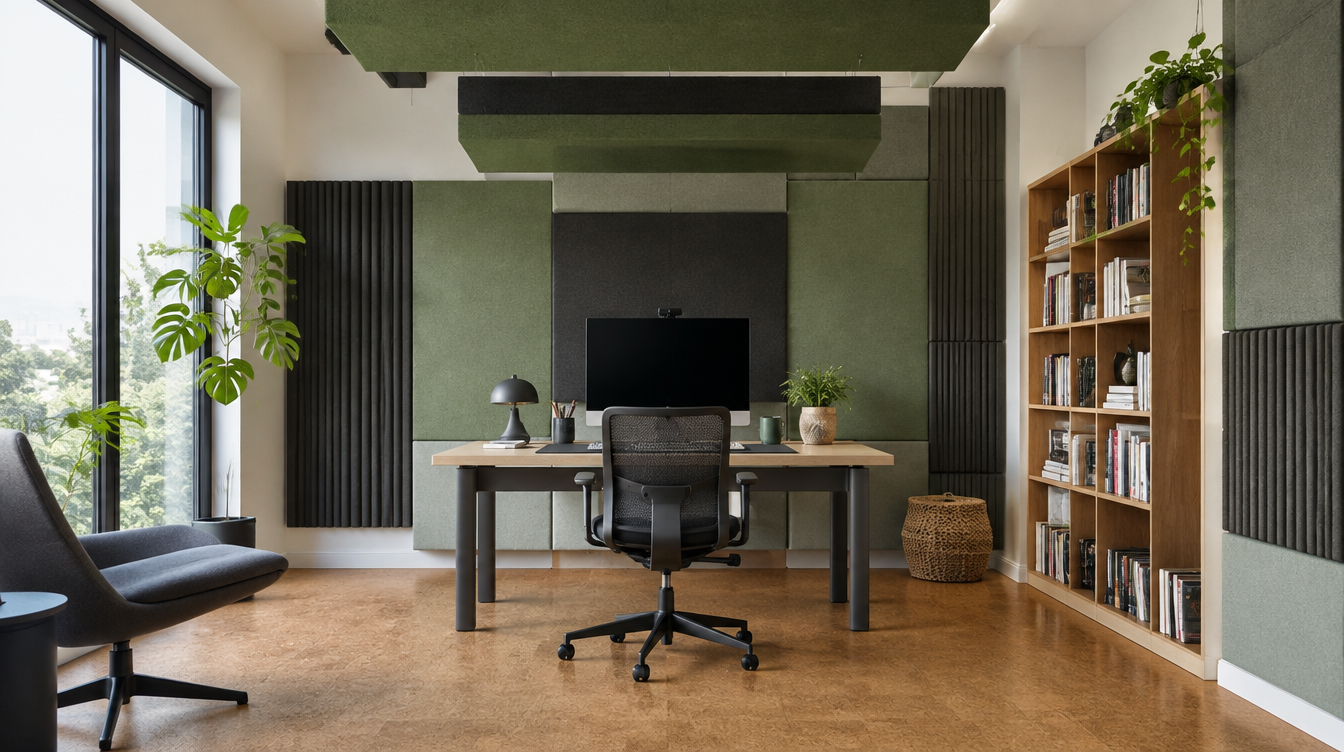
Two ways to do it. The first is a PET felt panel, 9 to 12 mm thick, made from recycled plastic bottles, fixed flat to a section of the ceiling or wall. It comes in 30 to 40 colours, can be cut into shapes, and at 12 mm has an NRC of roughly 0.4 to 0.5 at speech frequencies. Indicative Hyderabad material cost is ₹140 to ₹280 per sq ft, with installation adding ₹40 to ₹80 per sq ft.
The second is a suspended baffle or cloud, which is the same felt hung 100 to 150 mm below the ceiling so both faces work. This absorbs nearly twice as much per square foot as a flat-fixed panel and looks intentional over a dining table. It needs to be planned before the false ceiling is boarded, so the hanging points go in at the framing stage, exactly like a curtain box or a ceiling light point.
How much do you need? A rule of thumb for a living-dining room is absorptive coverage equal to 15 to 25 percent of the floor area, counting the rug and curtains. A 300 sq ft living-dining with a 48 sq ft rug and 60 sq ft of lined curtain on the balcony slider is already at about a third of that. One 40 to 60 sq ft ceiling cloud over the dining table usually closes the gap. Do not cover a whole wall. Over-absorbed rooms sound muffled and feel smaller.
Put the wall panel, if you use one, on the wall directly opposite the TV. That is the surface that sends dialogue back at you a split second late.
Fluted panels: what they do and do not do
Fluted panels, the vertical wooden slats on a backing board that are on every TV wall in Hyderabad right now, are sold as acoustic. The truth is mixed. The slats on their own diffuse a little. The real acoustic work is done by the black felt backing behind them, and only if there is an air gap or a felt layer of at least 9 mm. A charcoal or WPC fluted sheet glued flat to the wall with a paper-thin backing is decoration, not acoustics, and should be priced as decoration.

Ask the vendor for the NRC of the full assembly, slats plus backing, not just the felt. If they cannot produce a lab test sheet, assume the number is near zero and buy it because you like how it looks.
Blocking: doors, gaps and the work-from-home room
Now the other problem. If the issue is noise coming in, from the corridor, the road, or the next room, you are in blocking territory, and the fixes are heavier and plainer.
The door is almost always the weak point. A builder’s hollow flush door, 30 mm with a cardboard honeycomb inside, lets sound through like a curtain. A 35 mm solid-core flush door blocks noticeably more and costs ₹2,500 to ₹5,000 more per door. Then seal it. A 10 mm gap under a door undoes most of what the door does. A surface-mounted drop seal and a rubber perimeter seal together cost ₹1,500 to ₹3,500 per door fitted and are the best value item in this whole post. [VERIFY: door and seal rates]
Windows are next. Standard builder UPVC with 5 mm glass is decent. If you are on a road-facing side near a main road or the ORR, upgrading to 6.38 mm laminated glass or a double-glazed unit at ₹650 to ₹1,100 per sq ft makes a real difference, but only if the frame seals properly. Check your current windows by running a hand along the closed sash on a windy evening. If you feel air, you will hear traffic, whatever glass you fit.
For a work-from-home room, do both: solid door with seals, and a rug plus one felt panel behind your chair so your voice on calls does not ring. Plan the room’s sockets at the same time, since you will not want to open that wall twice.
What you cannot fix cheaply is the bedroom that shares a wall with the lift shaft or a neighbour’s bathroom, where the pipes carry the sound through the structure. That needs a second stud wall on resilient clips, 75 to 100 mm thick, and it eats floor space. Decide whether you can live with it before the design is frozen, because nobody retrofits that in a finished flat.
What to tell your designer
Say which rooms matter. Usually it is the living-dining (echo), the home office (voice on calls), and one bedroom facing the road (traffic). Say it before the false ceiling drawing is done, so hanging points, curtain boxes, and door specifications go in at the right stage. At D’leaps the acoustic layer is drawn on the same sheet as the ceiling and lighting plan, because that is where the decisions physically live.
Then do the clap test on handover day and again on moving day. If the second one still rings, you know which fix is missing.
Send us a 10-second voice memo of a clap in your empty living room on WhatsApp, with the room dimensions, and we will tell you whether furniture alone will fix it or you need a ceiling element.
Get a free modular kitchen quote from D'leaps
Planning your kitchen or a full-home fit-out? Talk to our designers for a free, no-obligation quote and a written completion date.
WhatsApp us on 9121000207 · Call +91 9121000207 · Book a free consultation
Related reading
- 3 BHK Interior Cost in Hyderabad 2026: The Honest Guide
What a 3 BHK actually costs in Hyderabad this year - broken down by finish tier, with the questions you should ask any studio before… - Limewash vs Microcement vs Tadelakt: Which to Choose
Limewash, microcement and tadelakt look alike in photos but fail differently. Where each works, indicative Hyderabad costs, and what to… - Circadian Lighting for Home: The Right Bulb for Every Hour
Circadian lighting for home, explained simply: which Kelvin to use from morning to night, room by room, with Hyderabad costs and a check… - What to Tell Your Interior Designer Before Design Starts
Pinterest shows a look, not your life. Here's what to tell your interior designer about your kitchen and storage so the design fits your… - Space-Saving Ideas for Small 2BHK Flats in Hyderabad
Small 2BHK space-saving ideas with real measurements: wardrobe, bed, dining and TV sizes, clearances, and the mistakes that eat floor space…