Limewash vs Microcement vs Tadelakt: Which to Choose
D'leaps Design Desk · 2026-10-18
Limewash, microcement and tadelakt look alike in photos but fail differently. Where each works, indicative Hyderabad costs, and what to check before you pay.
You have probably saved a photo of a wall that looks soft and cloudy, like old stone, with no tile joints and no paint strokes. It could be limewash, microcement or tadelakt. In a photo the three look close. On your wall, through a Hyderabad monsoon, they behave very differently, and the most expensive one can cost more than ten times the cheapest.
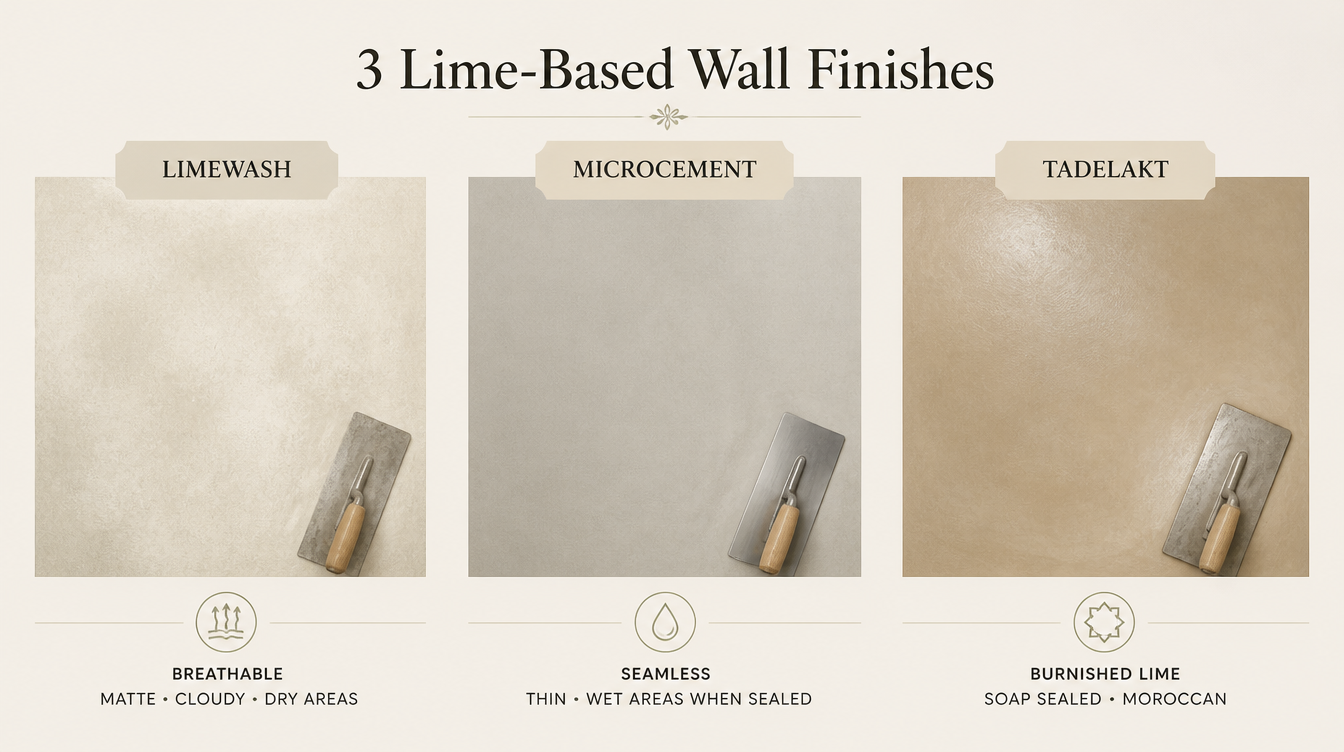
This limewash vs microcement vs tadelakt guide covers what each finish is, which rooms each can take, what it costs, and what to check on your own wall before you pay anyone an advance.
The short answer
Each of the three suits a different room. Pick by room first and by look second.
| Limewash | Microcement | Tadelakt | |
|---|---|---|---|
| What it is | Lime and water paint, brushed on in layers | Thin cement-based coating, trowelled in layers, then sealed | Moroccan lime plaster, polished with a stone and olive oil soap |
| Look | Matte, cloudy, brush-marked | Smooth, no grout lines, matte to satin | Soft gloss, rounded, hand-polished |
| Water | Poor. Keep it away from splash | Good only if the sealer is right | Naturally water-resistant |
| Where it fits | Living, bedrooms, feature walls, exteriors | Bathroom walls and floors, counters, living floors | Shower walls, wet rooms, curved tubs and vanities |
| Repair | Easy, brush over the patch | Needs the original applicator | Repairable by an artisan, about 2-3 days |
| Cost | Lowest | Middle to high | Highest |
The rule of thumb: dry room and a small budget, limewash. Wet room or floor, with a modern flat look, microcement. Wet room with curves, a warm glossy finish, and the budget and patience for an artisan, tadelakt.
Limewash: soft and breathable, but it marks
Limewash is slaked lime (lime that has been mixed with water and left to mature) thinned down and tinted with mineral pigments. It goes on with a wide brush in criss-cross strokes, two or three coats, and the cloudiness comes from the uneven way each coat soaks in.

It breathes, which means moisture inside the wall can escape through it instead of blistering it. That makes it a good choice for older homes with slightly damp walls and for exteriors.trade-off is wear. Limewash rubs off on hands and shoulders, and you cannot scrub it. In a home with small children, expect marks at 600 to 1,000mm height near switchboards and doorways within a year. Hyderabad dust settles into the matte surface and a wet cloth tends to leave a tide mark. Touch-ups are easy, but they never match perfectly, so plan to redo a whole wall rather than a patch.
One thing surprises everyone. Limewash dries much lighter than it looks wet. Judge the sample only after it has dried for at least 24 hours.
Microcement: no grout lines, but it is a coating, not waterproofing
Microcement is a polymer-modified cement (cement mixed with resins so it can be spread thin and still bond) applied in several trowelled layers and then sealed. The total build is thin, usually a few millimetres, so it can go on walls, floors, kitchen counters and shower areas without raising the floor level much.
It is the most durable of the three once sealed, and the easiest to wipe clean. That is why people choose it for bathrooms and floors.
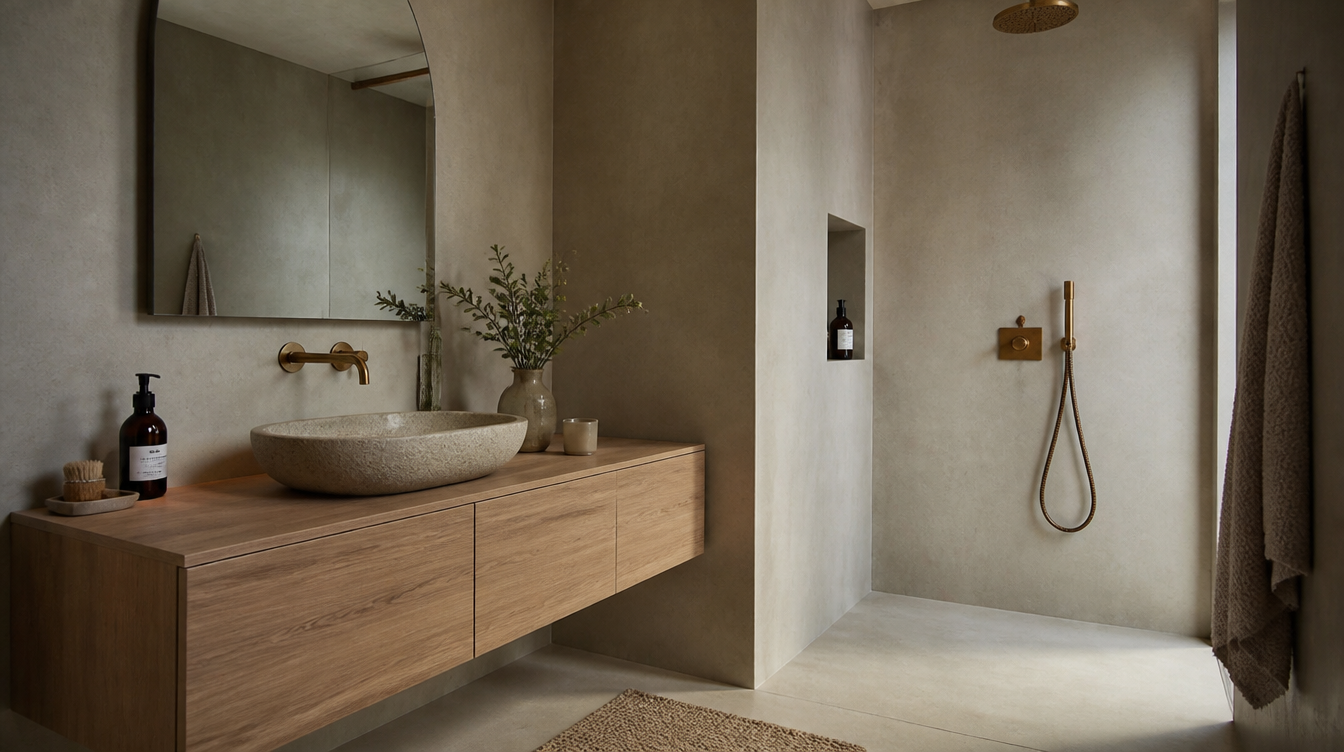
The common misunderstanding is about water. The cement layer is not waterproof. The sealer on top makes it water-resistant, and only if the right sealer is used in the right number of coats. In a shower, you still need a proper waterproofing membrane underneath, especially at the wall-floor junction and on any wall shared with a bedroom.
Microcement is often pitched as a way to cover old bathroom tiles without breaking them. It can work, but only if every tile is firmly bonded. Tap each one with a coin. A hollow sound means that tile is loose, and microcement over it will crack along the edge. Even over sound tiles, the grid of old joints can slowly show through as faint lines.
Floors need care too. Grit carried in on shoes scratches the sealer, so floor sealers need recoating every few years.
Tadelakt: the shower finish that takes a week
Tadelakt is lime plaster from Morocco, where it lined hammams (traditional steam baths). After the plaster is applied, an artisan polishes it for hours with a smooth stone, then rubs in black olive soap. The soap reacts with the lime and forms a thin water-repellent skin. That is where the soft gloss comes from.
It is the best of the three on curves. A rounded tub, a sculpted vanity or a shower niche with no corners is where tadelakt makes sense and the others struggle.

It is also slow and dependent on one person’s skill. A single shower can take several days of continuous work, and very few artisans in India do it well. This is not a DIY finish, and it is not one to give to a painter who has watched videos.
Expect a patina. Tadelakt darkens slightly where water hits most, and fine hairline cracks can appear, especially in the first year as the plaster settles. They can be repaired, typically over 2 to 3 days. Mesh tape at corners and junctions gives the plaster a little flexibility and reduces cracking. Keep tadelakt on walls and sculpted pieces. Floors that take daily foot traffic and grit will wear it.
What each costs in Hyderabad
Applicators usually quote per square metre. One square metre is about 10.76 sq ft, so convert before you compare against anything else in your quote.
| Finish | Indicative rate, supply and apply | Per m² | Typical time for one feature wall or one shower |
|---|---|---|---|
| Limewash | ₹80-200/sq ft | ₹860-2,150 | 2-3 days |
| Microcement | ₹300-700/sq ft | ₹3,200-7,500 | 5-8 days including sealer cure |
| Tadelakt | ₹800-2,000+/sq ft | ₹8,600-21,500+ | 5-10 days |
These are indicative ranges for Hyderabad at the time of writing. For comparison, ordinary texture paint runs ₹52-125/sq ft.
Price moves with three things: how bad your wall is, how much area there is (small areas cost more per sq ft because setup is fixed), and whose product is used. Imported microcement and limewash brands cost noticeably more than Indian ones. Always ask whether surface prep is inside the rate or billed separately. On a damaged wall, prep can cost almost as much as the finish.
Your wall decides more than the finish does
All three finishes crack, flake or stain for the same reason: the surface underneath moved, was damp, or was not flat. The finish cannot fix any of these. It shows them.
New flats. Most handover walls have putty and acrylic emulsion. Limewash will not soak into emulsion, so it needs a mineral primer first, and even then the effect is usually flatter. Microcement needs a bonding primer. Ask the applicator which one they will use and why.
Fresh plaster. If walls were replastered during civil work, they need at least 7 days of water curing and then time to dry out before any of these finishes go on. Rushing this is the most common cause of patchy limewash.
Cracks. A crack that keeps reopening means the wall is moving. In many newer Hyderabad towers, internal walls are RCC, which are steady, but the joint where an RCC wall meets a brick or AAC block wall moves. Microcement and tadelakt across that joint will crack along it unless mesh is embedded.
Two checks you can do today. Hold a long straight edge, an aluminium level or a straight batten, against the wall in several directions and look for gaps of more than about 3mm. Then tape a 600 x 600mm sheet of clear plastic to the wall, sealed on all sides, for 24 to 48 hours. Droplets on the inside of the sheet mean the wall is damp. Fix that first.
Three Hyderabad realities to plan for
Hard water and acid cleaners. Most limescale removers are acidic. Acid eats lime and cement. A single wipe with a descaler can permanently dull tadelakt and etch microcement. Use a squeegee after every shower and a pH-neutral cleaner, and tell your house help this in writing.
Monsoon humidity. Between June and September, coats dry slowly and sealers can cloud if trapped moisture is sealed in. Wet-area microcement and tadelakt are best scheduled for October to February.
Pooja rooms and kitchens. Diya soot, turmeric, kumkum and oil splashes stain matte limewash for good. In a pooja room, limewash the walls but keep the area within about 600mm of the lamp in a sealed finish or stone. Behind a kitchen hob, skip all three.
Five questions to ask before you pay an advance
- Will you make a sample board on my site? It should be at least 600 x 600mm, made with the same product, by the same person who will do the job, viewed in your actual daylight and under your evening lights. A 3000K bulb makes limewash look much warmer than daylight does.
- Can I see a job you did more than a year ago? A new job always looks good. A one-year-old shower tells you about the sealer and the cracks.
- What is the sealer, how many coats, and when does it need recoating? Get this in writing for any wet area, with a maintenance sheet you can hand to your household.
- Is prep inside the per-m² rate? Get the scope written: crack repair, primer, mesh, and who fixes the substrate if it fails.
- What happens if hairline cracks appear? Agree on a repair visit within a set period before work starts.
Tell your family up front that these are handmade finishes. Slight colour variation, trowel marks and patina are part of the look, not defects. If that bothers you, choose large-format porcelain tiles with tight joints instead. They give a similar calm look at a lower risk.
What to do next
Before you choose a finish, decide the room and test the wall. The plastic-sheet test and a straight edge will tell you more than any sample photo. If your wall fails either test, fix it first and choose the finish after.
If you’d like a second opinion, WhatsApp a photo of the wall and tell us which room it is in on +91 91210 00207, and we’ll tell you which of the three it can realistically take.
Get a free modular kitchen quote from D'leaps
Planning your kitchen or a full-home fit-out? Talk to our designers for a free, no-obligation quote and a written completion date.
WhatsApp us on 9121000207 · Call +91 9121000207 · Book a free consultation
Related reading
- How to choose Inteiror Designer in 2026
Three quotes for one 3BHK: ₹8.2L, ₹11.6L, ₹14.9L. How to choose an interior designer in Hyderabad, read a real quote, and spot what's… - Plywood vs MDF vs HDHMR: Which Board for Which Job
A plain-English guide to the boards your interiors are actually made of - where plywood, MDF and HDHMR each belong, and where they fail. - Acoustic Panels Will Not Soundproof Your Bedroom: An Honest Guide
Your new flat echoes because every surface is hard. Here is what absorbs, what blocks, a 30-second clap test, and what to spend on, in… - Circadian Lighting for Home: The Right Bulb for Every Hour
Circadian lighting for home, explained simply: which Kelvin to use from morning to night, room by room, with Hyderabad costs and a check… - What to Tell Your Interior Designer Before Design Starts
Pinterest shows a look, not your life. Here's what to tell your interior designer about your kitchen and storage so the design fits your…